
Table of Contents
- Why Business Mobile App Features Matter
- Benefits of Choosing the Right Mobile App Features
- 10 Must-Have Business Mobile App Features
- Bonus Features to Consider
- Common Mistakes Businesses Make
- How AarviApps Can Help
- Frequently Asked Questions
- Conclusion
Why Business Mobile App Features Matter
Mobile applications have become one of the most valuable digital assets for businesses. Whether you own a startup, retail business, healthcare company, educational platform, logistics service, or enterprise, a mobile app helps you connect directly with your customers.
However, simply launching an app isn’t enough. The success of your application depends on the business mobile app features you include. Customers today expect apps that are fast, secure, intuitive, and capable of solving real problems. If your app lacks essential features, users may uninstall it within days.
According to industry reports, users often abandon mobile apps because of poor performance, complicated navigation, slow loading times, or missing functionality. That’s why businesses should focus on delivering value through carefully selected features instead of filling an app with unnecessary options.
Choosing the right business mobile app features can help you:
- Increase customer engagement
- Improve user retention
- Strengthen customer loyalty
- Automate business operations
- Generate higher revenue
- Enhance your brand image
- Gain valuable customer insights
In this guide, we’ll explore the 10 must-have business mobile app features every company should consider when building a mobile application in 2026.
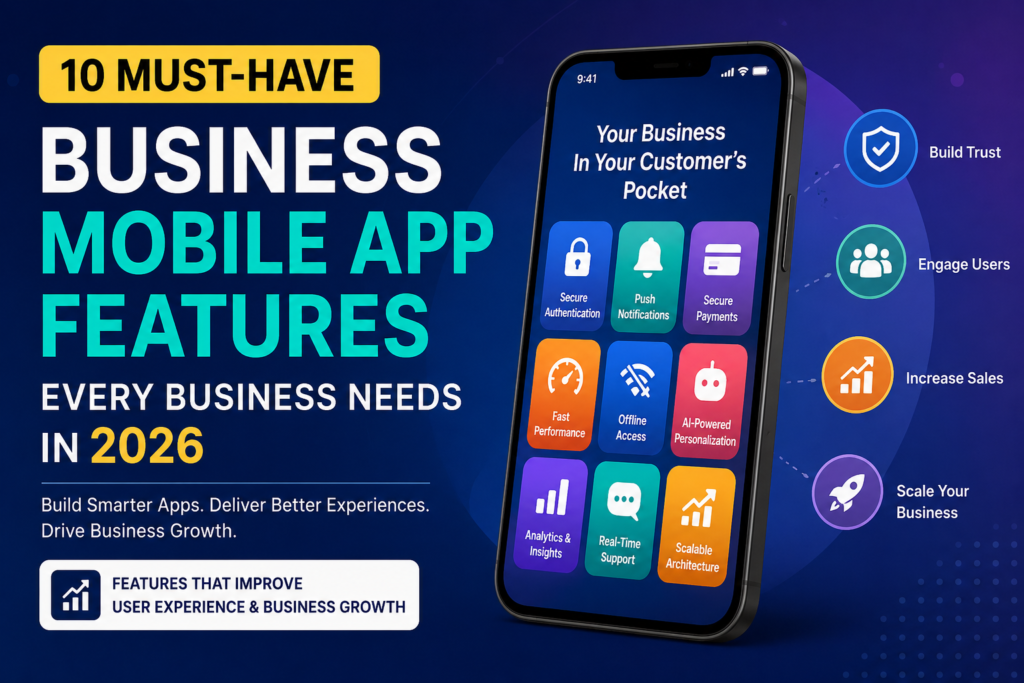
Benefits of Choosing the Right Business Mobile App Features
Before discussing the features, let’s understand why selecting the right functionality is important.
Better User Experience
Users expect mobile apps to be simple, fast, and easy to use. A clean interface combined with useful features creates a positive first impression and encourages users to keep coming back.
Higher Customer Retention
The more value your app provides, the more likely users are to continue using it. Features such as personalized recommendations, push notifications, and seamless navigation increase engagement and retention.
Improved Business Efficiency
Modern mobile apps can automate repetitive tasks such as appointment booking, customer support, payment processing, inventory updates, and order tracking. This saves time and reduces manual work.
Competitive Advantage
Thousands of new apps are released every month. Including the right business mobile app features helps your application stand out from competitors and strengthens your position in the market.
Increased Revenue Opportunities
Features like secure payments, subscriptions, loyalty programs, and personalized offers can directly contribute to higher sales and customer lifetime value.
1. Secure User Authentication
Security is the foundation of every successful business mobile application. Customers trust your app with their personal information, payment details, and sensitive data. Protecting this information should be your highest priority.
Modern authentication methods include:
- Email and password login
- Mobile number with OTP verification
- Google Sign-In
- Apple Sign-In
- Biometric authentication (Fingerprint & Face ID)
- Multi-Factor Authentication (MFA)
Businesses should also implement encrypted communication, secure password storage, and session management to minimize security risks.
Why It Matters
Strong authentication builds customer confidence, reduces fraudulent activities, and protects sensitive business information.
Best Practices
- Use secure authentication protocols.
- Enable biometric login where supported.
- Encrypt user data.
- Implement automatic session expiration.
- Offer password recovery options.
2. User-Friendly UI/UX Design
Even the most powerful application will struggle if users find it difficult to navigate.
An intuitive user interface (UI) and smooth user experience (UX) are essential business mobile app features that directly impact customer satisfaction.
A good design focuses on:
- Simple navigation
- Clean layouts
- Easy-to-read typography
- Consistent colors
- Accessible buttons
- Fast interactions
Users should be able to complete important tasks with minimal effort.
Why It Matters
Research consistently shows that users decide whether to continue using an app within the first few minutes. A confusing interface often results in higher uninstall rates.
Design Tips
- Keep navigation simple.
- Reduce unnecessary screens.
- Use clear icons and labels.
- Optimize for both Android and iOS devices.
- Follow platform-specific design guidelines.
3. Fast Performance and Speed
Performance is one of the most overlooked yet critical business mobile app features.
Users expect apps to open instantly, respond quickly, and perform smoothly. Slow loading times can negatively impact customer satisfaction and reduce retention.
To improve performance:
- Optimize images and media files.
- Reduce unnecessary animations.
- Cache frequently used data.
- Optimize API requests.
- Minimize app startup time.
- Compress network responses.
Business Benefits
A high-performing app leads to:
- Better App Store ratings
- Improved customer retention
- Lower uninstall rates
- Increased conversions
- Better search visibility within app stores
4. Push Notifications for Better Customer Engagement
One of the most valuable business mobile app features is push notifications. They allow businesses to communicate directly with users, even when the app isn’t open.
When used strategically, push notifications can increase user engagement, encourage repeat visits, and improve customer retention. However, sending too many irrelevant notifications can annoy users and lead them to disable notifications or uninstall the app.
Effective Uses of Push Notifications
- Promotional offers and discounts
- Order confirmations and shipping updates
- Appointment reminders
- New feature announcements
- Personalized product recommendations
- Cart abandonment reminders
- Payment due reminders
For example, an e-commerce app can notify customers about limited-time sales, while a healthcare app can remind patients about upcoming appointments.
Best Practices
- Personalize notifications based on user behavior.
- Schedule messages at appropriate times.
- Keep the content short and action-oriented.
- Allow users to customize notification preferences.
- Avoid sending unnecessary promotional messages.
Business Benefits
- Higher customer engagement
- Improved user retention
- Increased conversions
- Better customer communication
5. Secure Payment Gateway Integration
If your business mobile app involves purchases, subscriptions, or service bookings, secure payment integration is essential.
Customers expect a smooth, fast, and secure payment experience. A complicated checkout process often leads to abandoned transactions.
Popular payment methods include:
- Credit and Debit Cards
- UPI
- Digital Wallets
- Net Banking
- Subscription Payments
- Buy Now, Pay Later (BNPL)
A trusted payment gateway not only simplifies transactions but also builds customer confidence.
Essential Security Measures
- SSL encryption
- PCI DSS compliance
- Tokenized payment processing
- Secure API integration
- Fraud detection systems
Why It Matters
A seamless payment experience can significantly improve conversion rates and customer satisfaction.
Business Benefits
- Faster transactions
- Improved customer trust
- Reduced cart abandonment
- Increased sales
6. Offline Access and Data Synchronization
Internet connectivity isn’t always reliable. That’s why offline functionality has become one of the most valuable business mobile app features in 2026.
Allowing users to access essential information without an internet connection improves the overall user experience.
Examples include:
- Viewing previously loaded content
- Accessing downloaded documents
- Drafting forms
- Creating notes
- Browsing cached product catalogs
Once the device reconnects to the internet, the app should automatically synchronize new data with the server.
Industries That Benefit
- Healthcare
- Logistics
- Field Service
- Education
- Retail
- Manufacturing
Offline capabilities are especially useful for employees working in remote locations or areas with poor network coverage.
Business Benefits
- Better user experience
- Increased productivity
- Reduced workflow interruptions
- Higher customer satisfaction
7. AI-Powered Personalization
Artificial Intelligence is transforming mobile app experiences across every industry. Businesses are increasingly using AI to deliver personalized content, automate support, and improve customer engagement.
Adding AI-powered functionality makes your app smarter and more useful.
Popular AI features include:
- Personalized product recommendations
- Smart search suggestions
- AI chatbots
- Voice assistants
- Predictive search
- Content recommendations
- Customer behavior analysis
For example, a shopping app can recommend products based on browsing history, while a learning platform can suggest courses based on previous activity.
Why AI Matters
Customers appreciate experiences that feel tailored to their needs. AI helps businesses deliver relevant content and services while reducing manual effort.
Business Benefits
- Better customer engagement
- Higher conversion rates
- Improved customer satisfaction
- Reduced support workload
- Smarter business insights
Why These Business Mobile App Features Matter Together
Each feature discussed so far plays an important role, but their true value comes from working together.
Imagine a customer using your app:
- They log in securely using biometric authentication.
- They enjoy a clean and intuitive interface.
- The app responds quickly without delays.
- They receive a personalized push notification about a product they viewed yesterday.
- They complete their purchase using a secure payment gateway.
- They can still access important information even when they’re offline.
- The app recommends additional products using AI-powered personalization.
This seamless experience encourages users to stay engaged, return frequently, and recommend your app to others.
8. Analytics and User Insights
Launching your mobile app is only the beginning. To continuously improve user experience and business performance, you need to understand how people interact with your app. That’s why analytics is one of the most valuable business mobile app features.
Analytics tools help you monitor user behavior and identify areas for improvement.
Important Metrics to Track
- Daily Active Users (DAU)
- Monthly Active Users (MAU)
- Session duration
- Screen views
- User retention rate
- Conversion rate
- Customer acquisition source
- In-app purchases
- Feature usage
- Crash reports
These insights allow businesses to make data-driven decisions instead of relying on assumptions.
Example
Suppose users frequently abandon the checkout process. Analytics can help identify where they’re dropping off, allowing you to simplify the process and increase conversions.
Business Benefits
- Better decision-making
- Improved customer experience
- Higher conversion rates
- Continuous product improvement
- Increased return on investment
9. Real-Time Chat and Customer Support
Providing fast customer support can significantly improve user satisfaction. That’s why real-time chat has become one of the most requested business mobile app features.
Customers don’t want to wait hours—or even days—for answers. In-app messaging allows businesses to provide immediate assistance without requiring users to leave the app.
Customer Support Options
- Live chat with support agents
- AI-powered chatbots
- Help center
- FAQ section
- Ticket management
- Video support (for selected industries)
A hybrid approach works best. AI chatbots can handle common questions, while human agents manage more complex issues.
Industries That Benefit
- E-commerce
- Healthcare
- Finance
- Education
- Food Delivery
- Logistics
- Travel
Business Benefits
- Faster issue resolution
- Improved customer satisfaction
- Reduced support costs
- Higher customer retention
10. Scalable Architecture for Future Growth
Many businesses focus only on launching their app. However, a successful app should be built to support future growth.
A scalable architecture ensures that your app can handle:
- More users
- Higher traffic
- Additional features
- New integrations
- International expansion
- Increased data storage
Without scalability, businesses often face performance issues that require expensive redevelopment later.
Signs Your App Needs a Scalable Architecture
- Rapid user growth
- Frequent feature updates
- Expansion into multiple countries
- High transaction volumes
- Integration with multiple third-party services
Building scalability from day one saves both time and money.
Business Benefits
- Better long-term performance
- Lower maintenance costs
- Easier feature expansion
- Improved reliability
Bonus Business Mobile App Features Worth Considering
Depending on your industry, additional features can further improve user experience and business performance.
Some popular options include:
- QR Code Scanner
- GPS & Live Location Tracking
- Appointment Booking
- Loyalty and Rewards Programs
- Social Media Login
- Multi-language Support
- Dark Mode
- Voice Search
- File Upload
- Video Calling
- Barcode Scanner
- Wishlist
- Order Tracking
- Rating & Reviews
- Calendar Integration
Choose features based on your business goals and customer needs rather than trying to include everything in the first version of your app.
Common Mistakes Businesses Make When Choosing Mobile App Features
Adding the right features is important—but avoiding common mistakes is equally critical.
1. Adding Too Many Features
Trying to include every possible feature often results in a confusing and slow application. Focus on solving your users’ core problems first.
2. Ignoring User Experience
Even powerful functionality won’t help if users find the app difficult to navigate. Prioritize simplicity and usability.
3. Neglecting Security
Protecting customer data should never be an afterthought. Implement secure authentication, encryption, and regular security updates from the beginning.
4. Skipping User Testing
Testing your app with real users before launch helps identify usability issues, bugs, and opportunities for improvement.
5. Forgetting About Future Growth
Your app should be built with scalability in mind so it can evolve alongside your business.
Avoiding these mistakes increases the chances of building a successful and long-lasting mobile application.
Why Choose AarviApps for Mobile App Development?
Choosing the right development partner is just as important as choosing the right features.
At AarviApps, we help businesses transform ideas into high-performance mobile applications that are secure, scalable, and user-friendly.
Our services include:
- Custom Android App Development
- Custom iOS App Development
- Flutter App Development
- Cross-Platform App Development
- UI/UX Design
- API Development & Integration
- Payment Gateway Integration
- AI-Powered Mobile Applications
- App Maintenance & Support
- MVP Development for Startups
We focus on understanding your business objectives before writing a single line of code. This ensures your mobile application not only looks great but also delivers measurable business value.
Whether you’re launching your first app or upgrading an existing one, our experienced team is committed to building solutions that support your long-term growth.
Frequently Asked Questions
1. What are the most important business mobile app features?
The most important features include secure authentication, intuitive UI/UX, fast performance, push notifications, payment integration, analytics, AI-powered personalization, customer support, and scalable architecture.
2. Should every business mobile app include AI features?
Not necessarily. AI should be included when it solves a genuine business challenge, such as improving customer support, delivering personalized recommendations, or automating repetitive tasks.
3. How many features should a business mobile app have?
Start with the essential features required to solve your users’ primary problems. Additional functionality can be added in future updates based on user feedback and business growth.
4. How long does it take to develop a business mobile app?
The timeline depends on the complexity of the project. A simple MVP may take a few weeks, while a feature-rich enterprise application can take several months.
5. Why should I choose Flutter for business mobile app development?
Flutter enables developers to build high-quality Android and iOS applications from a single codebase, reducing development time and costs while maintaining excellent performance and a consistent user experience.
Conclusion
Building a successful mobile application requires more than an attractive design. The right business mobile app features determine how users interact with your app, how efficiently your business operates, and how well your application performs in a competitive market.
Features such as secure authentication, intuitive design, fast performance, push notifications, secure payments, offline functionality, AI-powered personalization, analytics, real-time support, and scalable architecture create a strong foundation for long-term success.
Rather than trying to include every available feature, focus on delivering real value to your users. Start with the essentials, gather feedback, and continue improving your app over time.
If you’re planning to build a business mobile app in 2026, partnering with an experienced development company can make all the difference.
At AarviApps, we specialize in developing custom Android, iOS, and Flutter applications that help businesses engage customers, streamline operations, and achieve sustainable growth. Whether you need an MVP for your startup or a feature-rich enterprise solution, our team is ready to bring your vision to life.
Ready to build your next mobile app? Contact AarviApps today to discuss your project and discover how we can turn your idea into a powerful, high-performing mobile application.